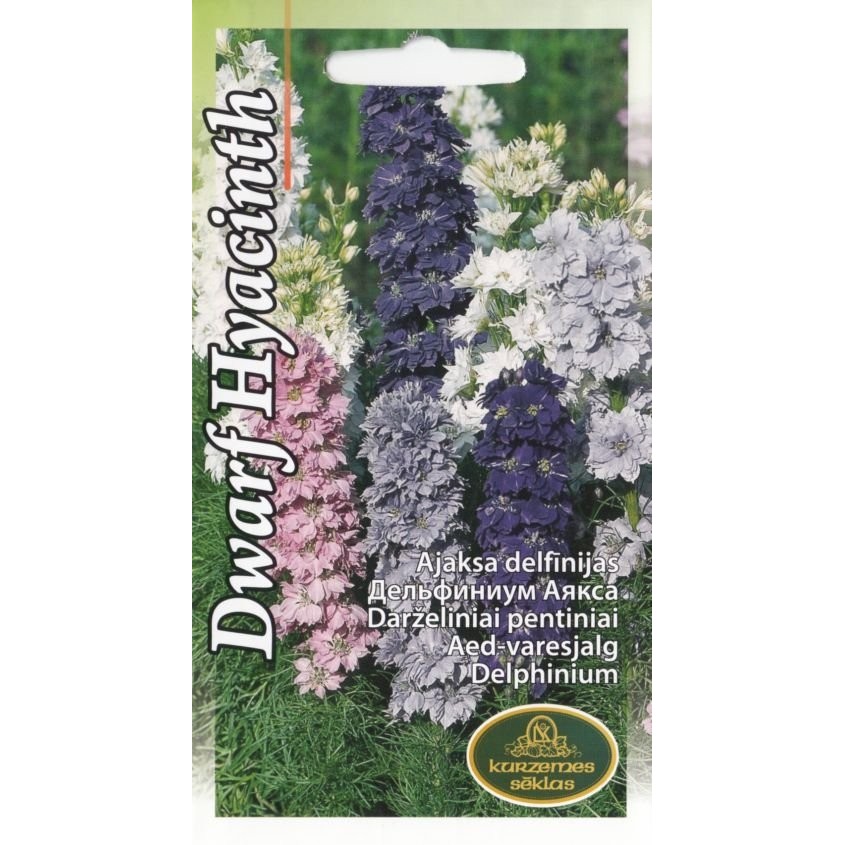
Summer larkspur "Dwarf Hyacinth", 0.5 g, KURZEMES SĒKLAS
Seller: ALLIKASILM
About this product
Larkspur “Dwarf Hyacinth” (Consolida ajacis) is an annual with dense, hyacinth-like spikes of double flowers. The mix carries blue, violet, pink and white shades.
The dwarf form grows 45–50 cm tall, stands up without staking and suits the front of a border as well as a large container. It flowers from July to September, cuts well and keeps its colour when dried.
The packet holds 0.5 g of seed (about 150–200 seeds), produced by KURZEMES SĒKLAS. Sow where the plants are to flower — larkspur has a taproot and dislikes being moved.
Note: all parts of the plant are poisonous if eaten. Avoid planting where small children play and wash your hands after handling.
Specifications
- Species: Consolida ajacis — rocket larkspur
- Variety: “Dwarf Hyacinth” — double-flowered dwarf mix
- Producer: KURZEMES SĒKLAS (Latvia)
- Packet: 0.5 g (about 150–200 seeds)
- Height: 45–50 cm
- Flowering: July to September
- Colours: mix of blue, violet, pink and white
- Position: full sun, sheltered from wind
- Soil: light, free-draining, neutral (pH 6.5–7.5)
- Sowing: direct outdoors in April–May, 0.5–1 cm deep
- Germination: 14–25 days at 15–18 °C
- Spacing: 15 cm between plants, 30 cm between rows
- Life cycle: annual, often self-seeds
- Uses: borders, containers, cut and dried flowers
- Toxicity: all parts are poisonous if swallowed
Advice from our agronomist
Sowing. Direct sowing in April–May is the safest route: larkspur has a taproot and resents transplanting. Sow 0.5–1 cm deep into soil of 15–18 °C — above 20 °C germination drops sharply. An autumn sowing (October) overwinters in the ground and gives earlier, stronger plants.
Thinning. Once seedlings are 5 cm tall, thin to 15 cm apart. Crowded rows give short spikes and more disease.
Water and feed. Water moderately, when the top of the soil dries — excess moisture leads to root rot. Give one balanced feed before flowering; too much nitrogen builds leaves at the expense of flowers.
Care. Cut spent spikes off and the plant sends up new spikes well into September. Leave a couple of spikes to ripen and it will self-seed and return to the same spot next year.
As a cut flower. Cut in the morning when the lowest third of the florets is open. Vase life is 5–7 days; keep away from ripening fruit, as ethylene makes the florets shatter. To dry, hang small bunches upside down in a dark, airy place.
Watch out for. Heavy wet soil (root rot), crowding and a cool rainy August (powdery mildew). Aphids arrive in dry spells — wash them off with water or use a soap solution.
Safety. The plant contains alkaloids and is poisonous if eaten, to people and animals alike. Do not plant next to a children's play area or an animal pen.
Codes and attributes
| Warehouse code | 2443 |
|---|---|
| Barcode | 4750128415014 |
| Category | Annual flowers & grasses |
Delivery and timing
- Parcel locker — €2.99–3.99, free from 59,00 €
- Courier to the door — €7.99–8.99, free from 99,00 €
- Dispatched within 2 working days